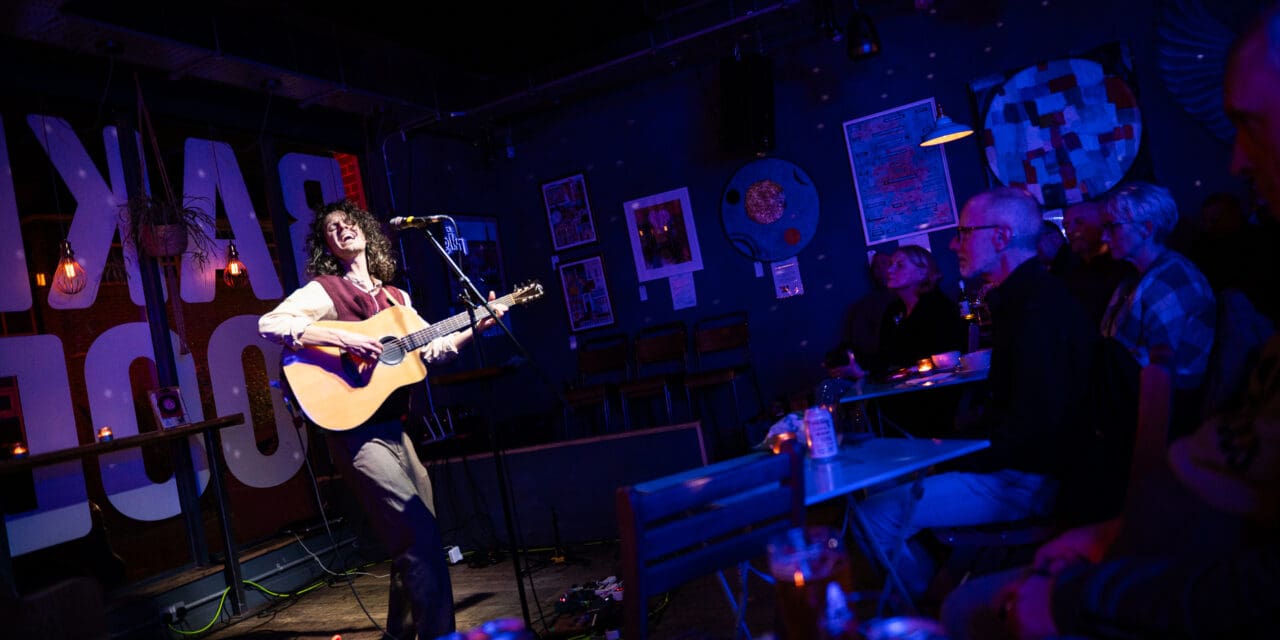
Cole Stacey tours his debut solo album, Postcards from Lost Places, to York venue, Rise at Bluebird Bakery. Taking place on Sunday 9th February, Yorkshire Coast Gigs journeyed along for a magical evening.
Whoever decided to put a disco ball in a bakery is a genius, let me tell you.
The venue, Rise at Bluebird Bakery in Acomb, York, is a magical little setting, glowing with warmth amidst a dreary Sunday evening in February. Beset with fairy lights and the kinetic reflections from said disco ball, this cosy, intimate café-style space begins to fill up with a sense of wonder and anticipation in the air.
To this setting arrives Cole Stacey; here to deliver songs from his debut solo album, Postcards from Lost Places. The album is an exploration of regeneration on many levels, blending contemporary folk stylings with traditional inspiration, with Stacey touring to a number of venues which, like this one, have found new modes and purpose after previous lives. Recently visiting the Yorkshire Coast to deliver a battalion of rock and pop synth hits as part of Midge Ure’s superb Catalogue tour, and having long been part of indie duo India Electric Co, this solo venture marks a cathartic departure for Cole Stacey.
First up is All We Are, a gently uplifting declaration of how love grounds us, adapted from a 17th Century anonymous poem called ‘Love Will Find Out The Way’. Played out on Stacey’s octave mandolin, this song evokes natural landscapes and metaphorical journeys, whilst the vocals captivate. Feast or Fire moves us up a gear, its warm tones and rich tapestry of yearning and evocation of place are delivered in sprightly fashion as mandolin and stomp box fuse in one of the decidedly more Americana-style tracks from the collection.
Hard Times (Come Again No More) sees Stacey move over to the piano, and I defy anyone to hear this, live or recorded, and not be stilled by its haunting beauty. The line “There’s a song that will linger forever in our ears…” could not be more apt.
Many of these songs are filled with poignant lyrics, delivered with a blend of uplifting bittersweet melancholy. If It Helps is a moment within a moment, its lilting pace carrying along the refrains that speak to life’s paradoxes, as Stacey explains its relevance to finding significant love and joy, at the same time as losing a loved one to their own battles. Between songs there is an occasional poem read aloud; it is fair to say that there is a thrall upon all spectators.
Humour and warmth are woven through the performance, not just in songs but in epistles on a Fiat 500 hire car being used for the tour, to the banter with former tour mates in the audience – and the crew from the former Midge Ure tour who are assembled here have not only travelled several hours to be there in support, but as soon as the gig ends they are checking phone calendars to see when they can come and see Cole Stacey again; I feel like these facts tells you everything about the quiet charm and loud talent of this performer.
Imagery-laden Sugarcanes is rich with proverbs and ironies; a sense of chagrin and even mischief seems to be infused in its depths. The first set also includes a small tribute to Midge Ure with a cover of Fade to Grey, given a folk slant like you’ve probably never heard before. Cole moves around the mandolin, piano and guitar, ending on the latter to perform For Old Time’s Sake, as by now (only paraphrasing slightly), ‘the twilight has gathered over and the daylight’s glory faded’; thankfully it’s still cosy and glittering inside the Bakery.
The second part begins with a surprising offstage start as we turn our heads to the sound of music from halfway in the crowd, then a brief ‘history lesson’, subverted by being declared to be ‘utter bollocks’; and so The Gatehouse is offered as a retelling of the tale of a strong woman whose supposed story was seemingly drafted by bitter misogyny; I make a mental note to look up Mary Howard, Duchess of Richmond and Somerset, once I’m home.
There are some songs from the India Electric Co back-catalogue, and another poem, one that features a soundscape recording from Stacey’s travels in Montmartre, which appears as a spoken word piece on the album; this is Lost Prayer – the words having also been laid out on postcards upon the café tables, and making for a small keepsake of the evening.
Another cover, Peter Gabriel’s Solsbury Hill, was chosen due to Stacey’s own local connection to Gabriel’s recording studio. The shining star in this half, however, is one of the stand-out tracks from the album; Quiet is Louder. It’s the kind of breathy, atmospheric song that could be soundtracking a TV series like ‘Unforgotten’. For me, it seems to hold its magic in perfectly conjuring those long dark nights of the soul, where time stands still whilst everything irrevocably changes.
We travelled some distance, but had not travelled the furthest of all present, to see Cole Stacey tonight. There’s a definite kind of draw that this visceral, honest music has, besides how genuine the musician behind it seems in his dealings with his music, and his audience. Postcards from Lost Places is an album that should find its way to many homes and venues, and Cole Stacey a performer whom we can only hope will travel this way again sometime soon.
You can still catch this tour on the dates below, and the album is available now – click here for Cole Stacey’s website.
26 February: London, Cecil Sharp House
28 February: Plymouth, St Paul’s Church, Yelverton
1 March: Truro, Devoran Acoustic